
Small Steps Towards Big Ideas: Socialisation Leading to Science
Admin
6 May 2026
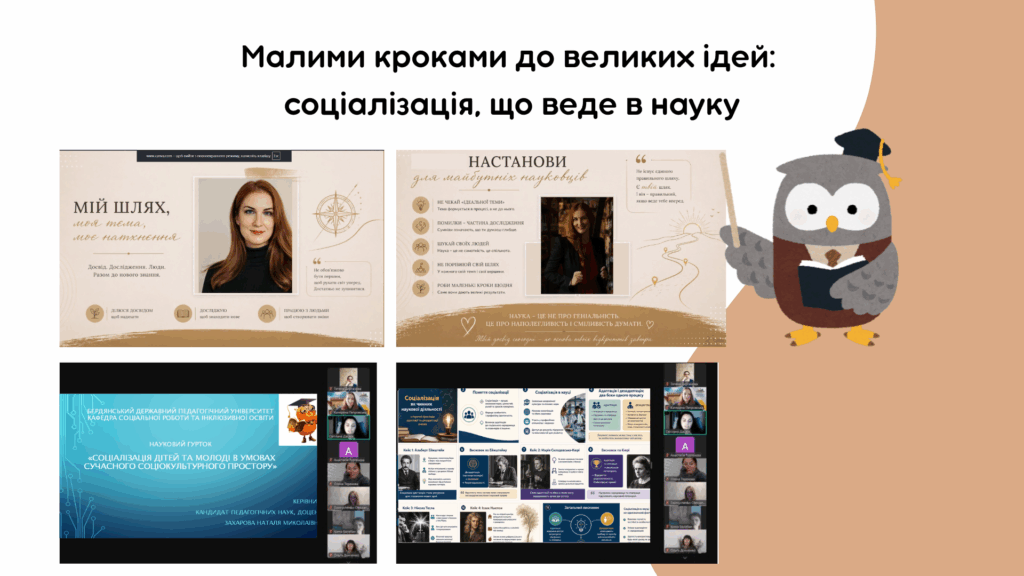
On April 29, another meeting of the student scientific club of the Department of Social Work and Inclusive Education, “Socialisation of Children and Youth in the Contemporary Socio-Cultural Space” (supervised by Associate Professor Nataliia Zakharova), took place. This time, the meeting acquired a special depth, becoming a space not only for discussion but also for rethinking personal experience, scientific orientations, and internal resources.
The club’s activities are traditionally based on openness to students’ interests. It is a space where ideas emerge at the intersection of personal experience and scientific inquiry, fostering critical thinking, research culture, and the ability to identify deeper meanings within everyday social processes.
The theme of the meeting, “Socialisation as a Factor in Scientific Activity,” along with the section “Science Opens the World,” set the tone for a meaningful and reflective discussion. The moderator emphasised that socialisation is not merely a background to life but a dynamic process in which scientific thinking, dialogue, creativity, and intellectual interaction are formed.
Participants noted that individuals often do not realise how they continuously experience states of adaptation and maladaptation, acceptance and rejection, search and doubt. These internal processes become the foundation for both personal and professional growth.
The interactive part of the meeting added particular value: students shared their own socialisation stories, recalling situations that required flexibility, resilience, and the search for new strategies. As one participant noted:
“For the first time, I saw my experience not as a difficulty, but as a resource that is already working for me.”
Within the context of scientific activity, the life stories of prominent scholars – Isaac Newton, Albert Einstein, Nikola Tesla, and Marie Skłodowska-Curie – were analysed. Their life paths convincingly demonstrate that even challenging social circumstances can become catalysts for discovery if a person finds internal resources and maintains a curiosity for knowledge.
A logical conclusion emerged: everyone has their own trajectory of development, and barriers are not stopping points but opportunities for growth.
Special interest was drawn to the section “Science Opens the World,” where stories of academic staff from the Department of Social Work and Inclusive Education are presented. Previous meetings featured inspiring talks by Professor Olha Hurenko and Associate Professor Anastasiia Popova, who emphasised that science is a path of perseverance, readiness to act, and the ability to see opportunities even in случайностях.
This time, the focus was on Candidate of Pedagogical Sciences, Associate Professor, and Head of the Department Kateryna Petrovska. Through her original method, she presented the metaphor of a “River” as her life and scientific journey:
- to explore in order to discover new knowledge;
- to work with people in order to create change;
- to share inspiring experience;
- to keep moving forward without stopping.
Her key messages for young researchers became guiding principles:
- science is courage of thought and daily work;
- science is not isolation, but community;
- everyone has their own path and their own вершини;
- small steps create big results;
- the right path is the one that leads forward.
As participants highlighted, such meetings “humanise” science, making it closer and more understandable: “When you hear a real story, you start to feel that you can walk this path too.”
The idea of popularising science through personal stories received a strong response among students. It not only reshapes perceptions of academics but also helps to see real and achievable models of professional development.
The meeting once again confirmed that a student scientific club is not just an educational format but a living space for development, where interest in research is born, professional identity is shaped, and one’s own path in science is discovered.
Based on materials from the Department of Social Work and Inclusive Education
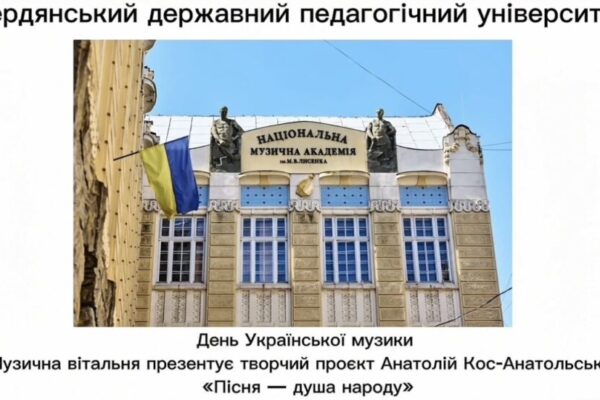
The Department of Theory and Methods of Teaching Artistic Disciplines of the BSPU presents a creative project Anatoliy Kos-Anatolskyi «Song is the Soul of the People»
Anatoliy Kos-Anatolskyi (1909-1983) - an outstanding composer and teacher, pianist,…
23 September 2026
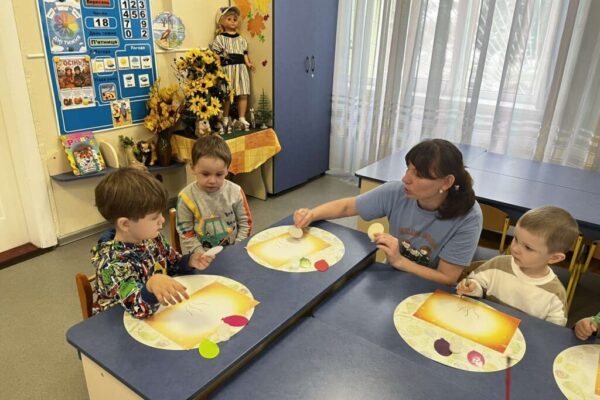
Future educators gain their first teaching experience
On the eve of Preschool Education Day, students from group…
23 September 2026
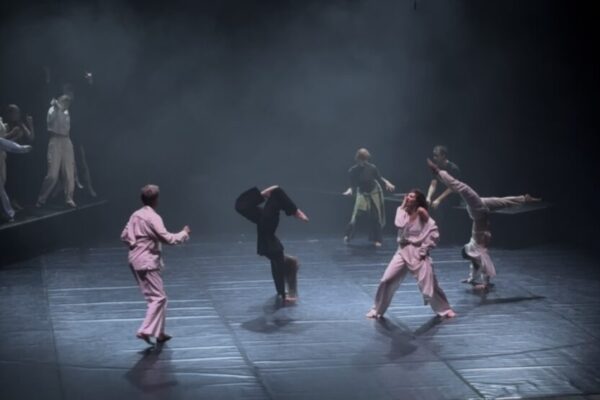
Yuliia Skyba at the 2nd International Dance Festival “MZ FEST” of the Maria Zankovetska Theatre
The Second International Dance Festival “MZ FEST” was held at…
22 September 2026

Perform Ukraine 2026: A Space for Professional Dialogue, New Ideas and Partnerships
On September 16–17, Associate Professor and Head of the Department…
22 September 2026