
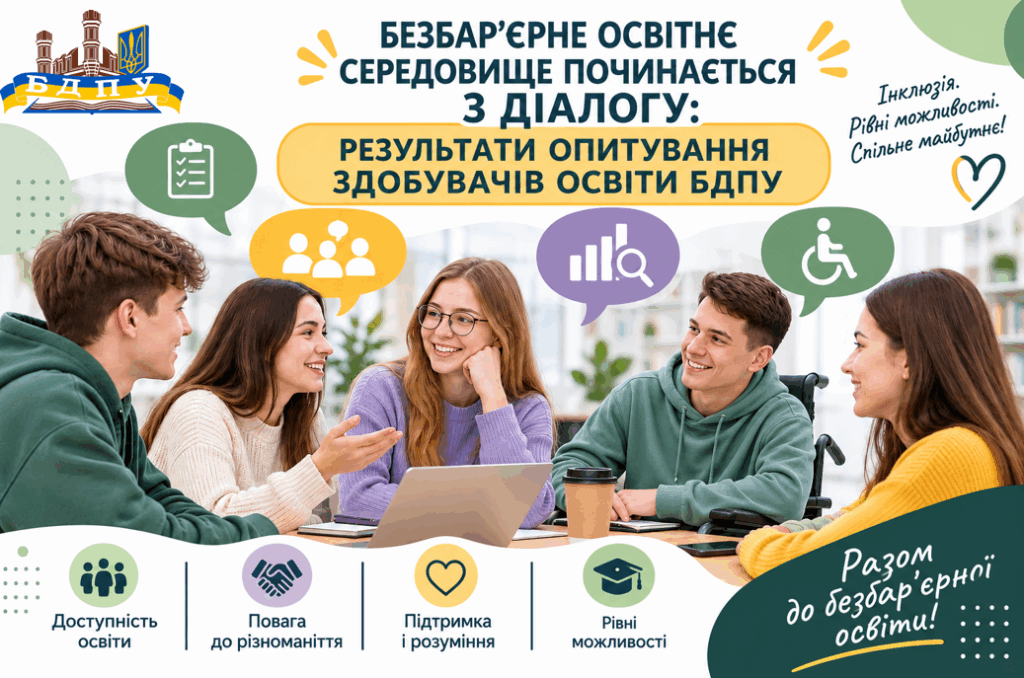
An inclusive and barrier-free educational environment begins with dialogue: results of a survey of students at berdiansk state pedagogical university
Admin
18 November 2026
Creating an accessible, barrier-free, and comfortable educational environment is not merely a matter of complying with regulatory requirements. Above all, it means being attentive to the needs of every participant in the educational process. It is important not simply to declare equal opportunities, but to listen to students, take their experiences into account, and work together to find solutions that enable everyone to realise their educational potential.
With this aim in mind, the Competence Centre for Inclusive Education of Berdiansk State Pedagogical University (BSPU) conducted a survey of higher education students to identify special educational needs and the support conditions required during their studies. It is important to note that participation in the survey was voluntary.
A total of 121 higher education students took part in the survey. Among the respondents, 65 were Bachelor’s degree students (53.7%), while 56 were students pursuing second- and third-cycle higher education degrees (46.3%). Responses were received from representatives of all university faculties, providing a broader understanding of the needs of the student community.
According to the survey results, 9 respondents (7.4%) reported having an officially recognised disability, 5 respondents (4.1%) indicated that they had special educational needs that should be taken into account during their studies, and another 5 participants (4.1%) found it difficult to provide a definite answer. At the same time, 111 respondents (91.7%) did not report having special educational needs.
It is important to emphasise that an inclusive educational environment is essential not only for people with officially recognised disabilities or identified special educational needs. It also requires flexibility, accessibility, and the university’s willingness to take into account students’ diverse life circumstances, abilities, and educational needs.
Most survey participants indicated that they did not require additional study arrangements. However, the responses of those who identified a need for support highlighted the importance of several key areas:
- Flexibility in the educational process – opportunities to adjust deadlines, methods of completing academic assignments, and assessment formats;
- Accessible learning materials – providing materials in convenient formats, using an adequate font size, allowing text enlargement, and ensuring appropriate visual accessibility;
- Consideration of individual working pace – including providing additional time to complete online tests and assignments;
- Organisational support – timely communication and accessible timetables, links to classes, and learning materials;
- Psychological and social support, as well as the opportunity to receive individual consultations regarding the learning conditions required.
The open-ended responses were particularly valuable, as each one reflected a real learning experience. Students highlighted the need for greater flexibility in assignment deadlines, consideration of the challenges of combining studies with employment and family responsibilities, and improved accessibility of electronic learning materials and tests for people with visual impairments. They also expressed a desire for expanded opportunities for distance learning, flexible class schedules, access to learning materials at convenient times, and the introduction of tutoring support for students with special educational needs.
At the same time, respondents also shared positive assessments of the organisation of the educational process, particularly the convenience of timetables with embedded links and the overall atmosphere of interaction within the university. This demonstrates the importance of existing good practices and the need to further develop them.
The results obtained will not remain merely statistical data. They will serve as a foundation for the further work of the Competence Centre for Inclusive Education and its cooperation with the university’s faculties and structural units.
The priority areas of work for the 2026–2027 academic year include:
- Applying recommendations developed within the framework of the Inclusive Educational Environment in Higher Education Institutions project for academic and teaching staff on creating accessible learning materials and adopting flexible approaches to organising the educational process;
- Promoting the consideration of students’ individual needs when completing assignments, taking tests, and assessing learning outcomes;
- Providing consultations for students and academic staff on inclusive education and reasonable accommodation;
- Enhancing the information accessibility of the educational process;
- Strengthening cooperation between the Competence Centre, faculties, and other university units to ensure timely responses to individual requests;
- Continuing to monitor students’ needs and evaluate the effectiveness of the measures implemented.
It is particularly important that work with individual requests will ensure confidentiality and respect for each student’s personal information.
The survey has once again confirmed that barrier-free access does not mean providing identical conditions for everyone. It means ensuring that each person receives the support they need to participate fully in the educational process.
The Competence Centre for Inclusive Education of BSPU expresses its sincere gratitude to all students who took part in the survey and shared their experiences and suggestions. It is through open dialogue, active engagement, and shared responsibility that we can create a university environment where diversity is valued, dignity is respected, and opportunities are available to everyone.
We listen. We take needs into account. We take action. Together, we are building a barrier-free educational environment!
Prepared by the Competence Centre for Inclusive Education,
Berdiansk State Pedagogical University
«Stopmines. Life without risk»: an informational meeting with representatives of the HALO Trust was held at BDPU
On 12 November 2026, Berdіansk State Pedagogical University hosted a…
18 November 2026

Language, Culture and Identity in the Focus of International Academic Dialogue: Berdyansk State Pedagogical University Hosts the Conference “Language and Society: The Ethnocultural Dimension”
Language as a factor in national identity, ethnocultural memory, media…
18 November 2026

Youth Policy Unfiltered: From an Idea to Real Change
On November 13, an open meeting titled “Youth Policy Unfiltered”…
17 November 2026

Practice-Oriented Training of Law Students
In the autumn of 2026, within the framework of clinical…
17 November 2026