
Leiden Madtrics about GAIDeT: promoting the responsible use of AI
Admin
10 September 2025
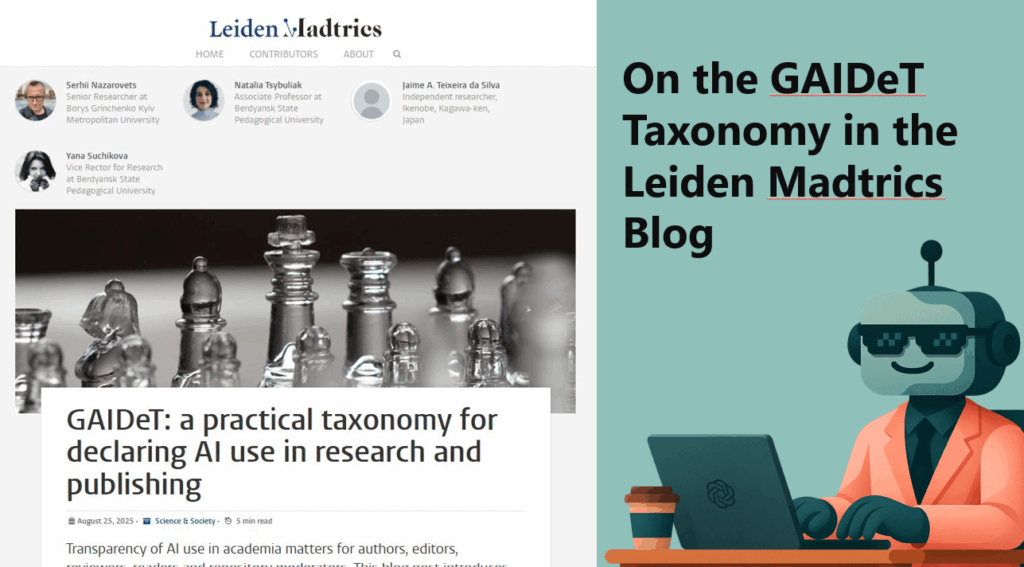
The Leiden Madtrics blog of the Centre for Science and Technology Studies (CWTS) at Leiden University has published a feature on the GAIDeT taxonomy for transparent disclosure of AI contributions, developed by BSPU researchers together with international colleagues.
The Center for Science and Technology Studies (CWTS) is a research institute affiliated with Leiden University. Experts specialize in several areas: integrating society into the research system, fostering a healthy research culture, ensuring the openness of such data, and, in particular, responsible evaluation of research outputs. Our taxonomy is dedicated to achieving these goals.
What is GAIDeT and why does it matter?
GAIDeT (Generative AI Delegation Taxonomy) is a simple, practical language for clearly explaining which tasks and at what stage of research were delegated to AI, with an explicit emphasis that responsibility always remains with the human researcher. The taxonomy shifts the focus from vague statements to standardized accountability, understandable to authors, editors, reviewers, repository moderators, and readers alike.
Where to read more:
- Blog post: “GAIDeT: a practical taxonomy for declaring AI use in research and publishing” (August 25, 2025).
- Scientific article: Suchikova, Y., Tsybuliak, N., Teixeira da Silva, J. A., & Nazarovets, S. (2025). GAIDeT (Generative AI Delegation Taxonomy): A taxonomy for humans to delegate tasks to generative artificial intelligence in scientific research and publishing. Accountability in Research. doi:10.1080/08989621.2025.2544331. (Online ahead of print, August 8, 2025).
BSPU’s Position
We are convinced that it is time for Ukrainian universities to integrate GAIDeT into their academic integrity policies and internal rules on AI use. This will make transparency a safe and routine practice, not a cause for stigmatization. It is not about control or “witch hunts,” but about restoring trust in science. The publication in Leiden Madtrics is a strong signal that GAIDeT is not only a conceptual framework but a ready-to-use tool for immediate implementation.
Publication in one of the world’s leading hubs of metascience and scientometrics confirms the growing global interest in the practical implementation of our approaches to responsible AI use.
Daria Kizilova

The Unity of Science and Education: Ihor Bohdanov Participated in the General Meeting of the National Academy of Educational Sciences of Ukraine
Ihor Bohdanov, Rector of Berdyansk State Pedagogical University, attended the…
19 September 2026

Start of the New Academic Year: Meeting of the BSPU Council of Young Scientists
On September 17, 2026, an extended meeting of the Council…
18 September 2026
Representatives of the Department of Choreography and Fitness at BDPU Join the Discussion of the New Higher Education Standard
On September 15, 2026, Associate Professors of the Department of…
17 September 2026

When Numbers Become Arithmetic Sculptures: How Triangles Are Born from Simple Sums
A boat rental lifeguard is screaming into a megaphone:– Boat…
16 September 2026