
“BSPU Integral”: Bringing Knowledge Together – Creating the Future!
Admin
10 November 2026
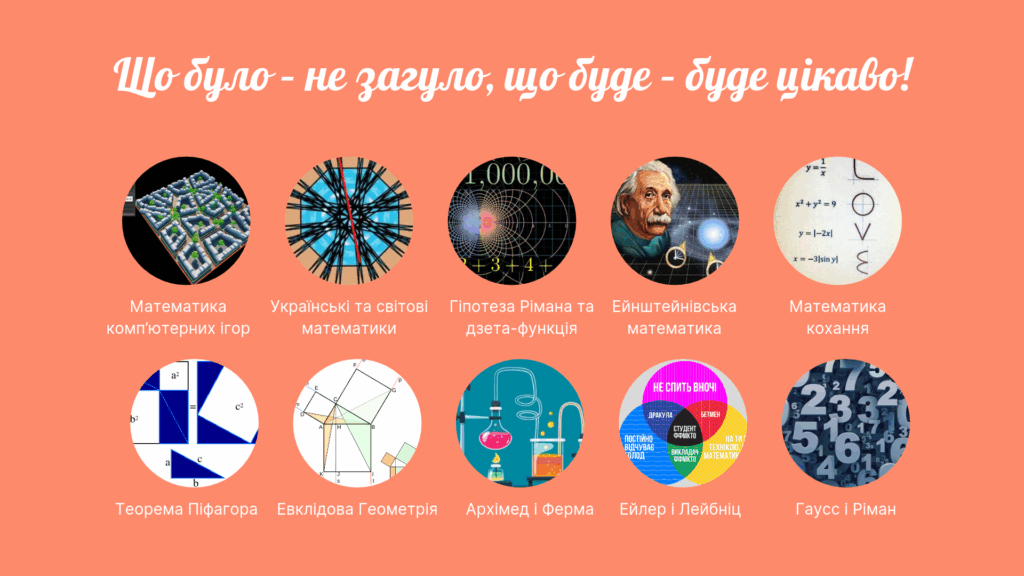
Two years may be just a fleeting moment on the scale of mathematical infinity, yet they are more than enough time to establish a tradition, build a community, and achieve the first significant results. In the first week of November, the Mathematics Club of Berdyansk State Pedagogical University (BSPU) celebrated its second anniversary. Over this period, it has evolved from an initiative for students interested in mathematics into a community that brings together mathematical ideas, STEM approaches, research, and people from diverse academic backgrounds.
The club marked its second anniversary with a new name, “BSPU Integral,” and the slogan “Bringing Knowledge Together – Creating the Future!” This is more than just a change of name. The integral symbolizes the bringing together of individual elements into a unified whole, and this is precisely the idea we seek to put into practice through the club’s activities: combining mathematics and STEM, theoretical knowledge and practical applications, fundamental scientific ideas and modern technologies, as well as individual interests and collective creativity.
Over the past two years, 99 people have registered with the club! Including its leader, the “BSPU Integral” Google Group now has exactly 100 members. This is more than just an impressive anniversary figure: the group has become a kind of digital archive of our activities. It contains materials from club meetings dating back to 2024, allowing every member to explore the topics, ideas, and outcomes of previous sessions asynchronously, revisit interesting materials, or discover something they may have missed at the time.
One of the most important achievements of these two years has been the club members’ research output. Of the 37 conference abstracts prepared by students for international and all-Ukrainian academic conferences under the supervision of Mykola Kudinov, Associate Professor at the BSPU Department of Physics, Mathematics and Teaching Methods, 27 (73%) were authored by club members. Behind each of these publications lies an independent search for ideas, a study of relevant sources, mathematical reasoning, the support and academic mentorship of the club leader, and attempts to formulate original ideas and present them to the academic community.
It is particularly encouraging that “BSPU Integral” is not limited to a single faculty and is open to everyone interested in mathematics, STEM, and intellectual pursuits. Since March 2026, an active club member has been a student from the Faculty of Psychological and Pedagogical Education and Arts. During the anniversary week, three more representatives of this faculty’s student self-government joined the community: the Chair and Secretary of the Student Council, as well as the Head of one of its sectors.
This is particularly symbolic because mathematics is essential not only for those who will teach it in general secondary education institutions in the future. It develops logical thinking, the ability to recognize patterns, analyze information, and find unconventional solutions. We hope that this collaboration will strengthen the mathematical and STEM components of the training of future preschool and primary school educators. After all, they have an important mission: to help a new generation of children discover the world of knowledge, feel confident when facing challenging questions, and develop curiosity and an interest in exploration from an early age.
We understand that not everyone interested in the club can attend online meetings at scheduled times. Therefore, alongside our Google Group, we also have a dedicated messaging group where the club leader shares materials, which are especially useful for those who could not attend a session. We also hold a weekly poll to determine a convenient time for the next meeting. Club members choose the time slots that suit them, and the results help us select the time when the largest possible number of participants can join. This approach allows us to plan activities flexibly, take academic schedules into account, and maintain regular meetings.
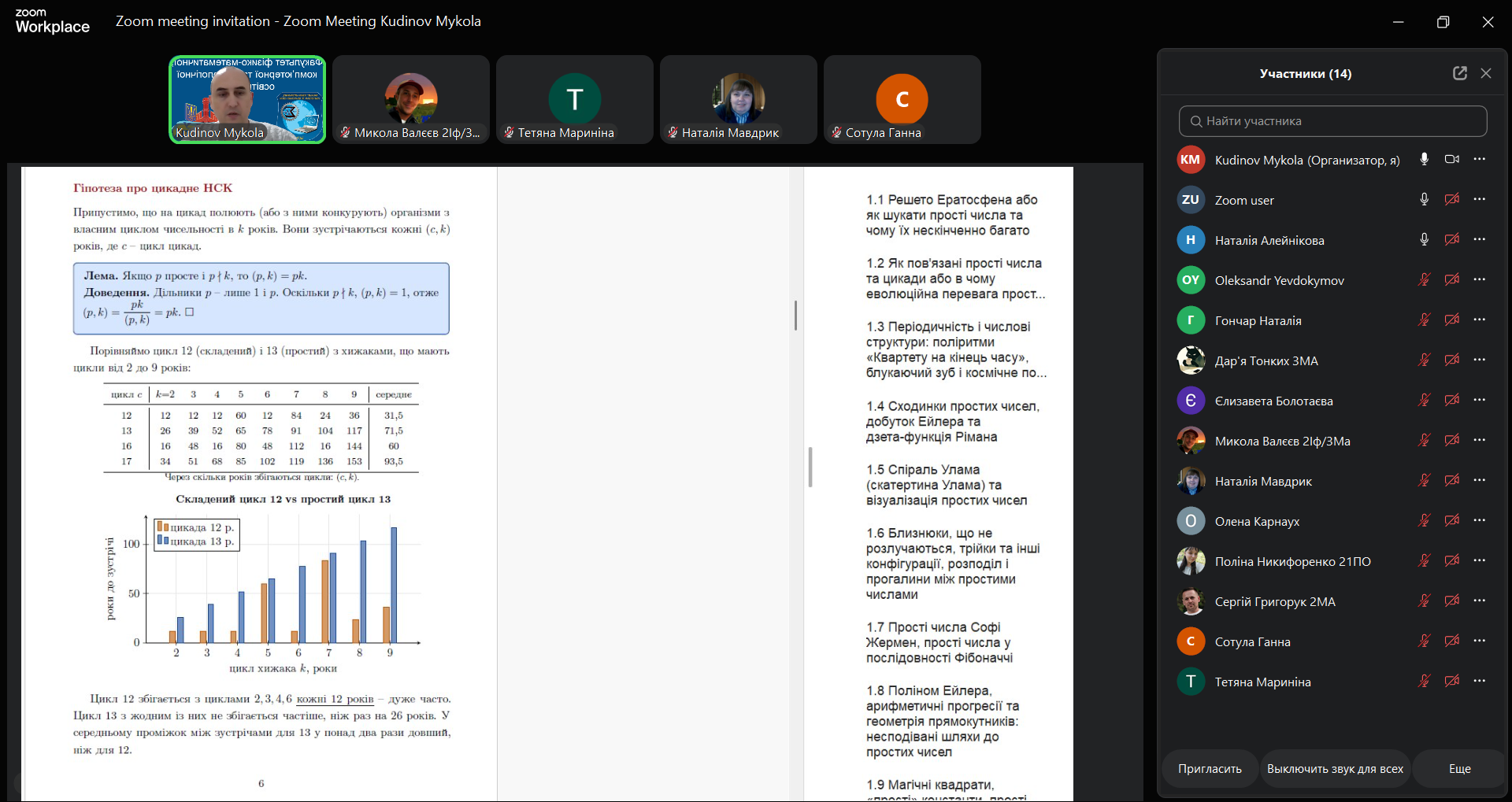
Our anniversary session was devoted to prime numbers in the world around us. We explored them as a phenomenon that unexpectedly connects mathematics with nature, music, mechanics, and even the search for extraterrestrial intelligence.
Why do some species of periodical cicadas emerge above ground at intervals of 13 or 17 years? These are prime numbers, and their distinctive arithmetic properties may offer an evolutionary advantage, in particular by reducing the likelihood of their life cycles coinciding with those of predators. Mathematics thus helps us uncover the hidden logic behind natural rhythms.
After listening to an excerpt from Quartet for the End of Time by French composer Olivier Messiaen, written in 1940 in a prisoner-of-war camp and first performed there in January 1941, we paid particular attention to the first movement, Liturgie de cristal. In this movement, a rhythmic cycle of 17 durations is superimposed on a harmonic cycle of 29 chords. Both numbers are prime, and the two cycles would fully realign only after 17 × 29 = 493 steps. This interaction creates an impression of motion that seems to repeat itself, yet each time unfolds in a different combination. Here, mathematics is not merely a tool for analyzing music but becomes part of its artistic architecture.
We found another unexpected example in mechanical engineering. Imagine two meshing gears with M and N teeth, respectively. Over a complete cycle, each tooth of the first gear will come into contact with N/gcd(M, N) different teeth of the second gear. If the numbers of teeth are relatively prime, that is, gcd(M, N) = 1, every tooth of the first gear will meet every tooth of the second. This principle is known as the “hunting tooth” principle: it helps distribute wear more evenly across the gear teeth. Once again, a property of prime numbers proves useful far beyond purely mathematical problems!
We also discussed the Arecibo message, transmitted on November 16, 1974, from the Arecibo radio telescope toward the globular star cluster M13. It contained 1,679 bits of information. But why exactly this number? Because 1,679 = 23 × 73, the product of two prime numbers. This makes it possible to arrange the bit sequence into a 23 × 73 rectangle, revealing the two-dimensional structure of the encoded message. This idea echoes Carl Sagan’s novel Contact (1985) and its 1997 film adaptation, in which scientists recognize the artificial origin of a cosmic signal through a sequence of pulses corresponding to prime numbers: 2, 3, 5, 7, …, 101. After all, natural processes have no obvious reason to reproduce precisely such a sequence, whereas for an intelligent civilization it could serve as a kind of mathematical “handshake.”
These examples are only a small part of what the world of prime numbers has to offer. They remind us that mathematics is not confined to textbooks and formulas: it resonates in music, lies hidden in natural cycles, operates in mechanical systems, helps transmit information, and can even become the language of an imaginary interstellar dialogue. It is precisely these unexpected connections that make our meetings special.
Two years have already become a story we have created together, but they are also just the beginning. “BSPU Integral” continues to grow, explore new areas, welcome participants from across Ukraine and around the world, and turn curiosity about mathematics into collaborative research and creative projects. We are delighted to welcome everyone who wants not simply to receive ready-made answers but to ask questions, seek patterns, experiment, and share their own discoveries.
So let us bring knowledge together and create the future! If you are passionate about mathematics, STEM, scientific mysteries, and intellectual adventures, we invite you to join our community!
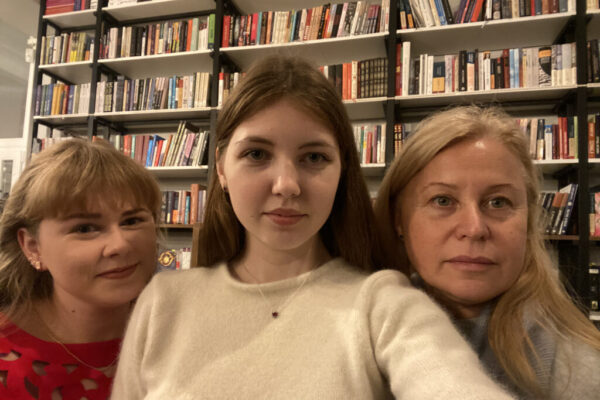
Mariupol Living in Memories: BDPU Students Attend the Presentation of a Documentary Book by Maks Hrabovskyi
On November 6, Kateryna Bukhtiiarova and Alona Neizzhala, students from…
10 November 2026
Information hygiene as an everyday choice
Every day we scroll through feeds, listen to music, and…
10 November 2026
Foundations of Ethical Interaction with People with Disabilities and Children with Master’s Thesis Pre-Defense: A Step Towards Final Assessment
The Department of Applied Psychology and Speech Therapy at Berdyansk…
10 November 2026
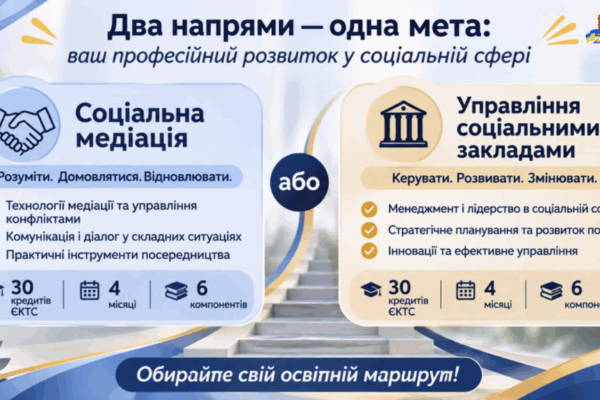
Certificate Programmes Presented to Berdyansk State Pedagogical University Master’s Students to Support Individual Learning Pathways
On 5 November 2026, the Department of Social Work and…
9 November 2026