
From Individual Needs to Coordinated Services: BSPU Hosts a Guest Lecture on Community-Based Social Support for Future Social Work Professionals
Admin
31 October 2026
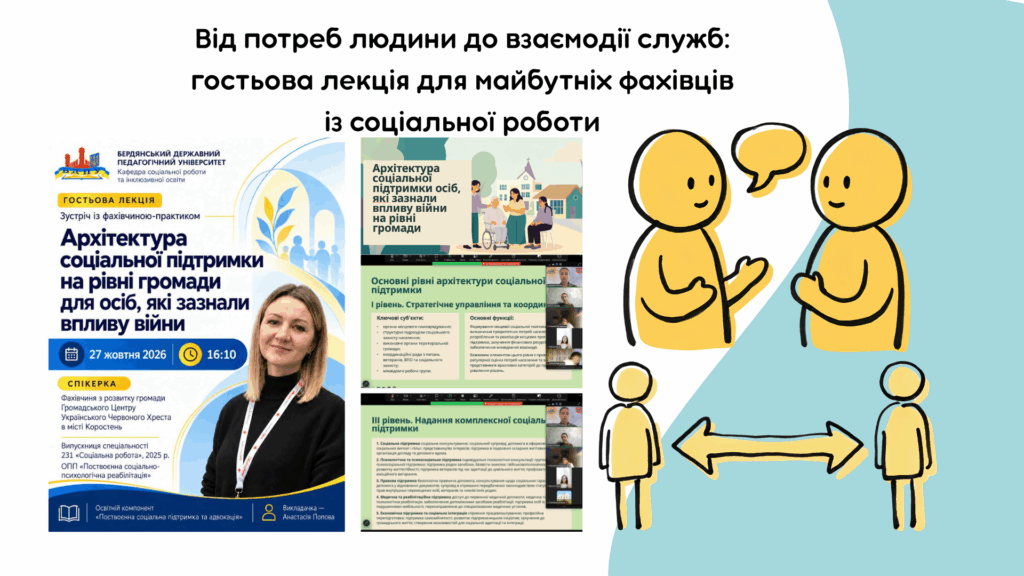
How can assistance for a person affected by war be organised to ensure timely support and ongoing follow-up? How can cooperation be established between social services, local authorities, psychologists, and humanitarian organisations? These questions formed the basis of the guest lecture “The Architecture of Community-Based Social Support for People Affected by War”, delivered to students at Berdyansk State Pedagogical University.
The event was organised within the degree programme “Post-War Social and Psychological Reintegration” as part of the course “Post-War Social Support and Advocacy”, taught by Anastasiia Popova, Associate Professor in the Department of Social Work and Inclusive Education.
The guest speaker, Nataliia, is a community development specialist at the Community Centre of the Korosten City and District Branch of the Ukrainian Red Cross Society and a practising psychologist at the Resilience Centre. The meeting was particularly meaningful because she is a 2025 BSPU graduate in Specialty 231 Social Work (now I10 Social Work and Counselling), having completed the degree programme “Post-War Social and Psychological Rehabilitation” (now “Post-War Social and Psychological Reintegration”). Returning to the university classroom as a practitioner gave her an opportunity to share her professional experience and demonstrate how the knowledge acquired during her studies informs her work with individuals and communities.
During the lecture, the speaker presented four interconnected levels of social support provision: strategic management and coordination; needs identification and initial contact; comprehensive support; and specialised assistance and interagency referral. This approach helped students explore how community-level decisions relate to professionals’ daily work and individuals’ access to services.
Particular attention was paid to the service user’s pathway: from an initial request for assistance or the identification of a need through an assessment of the person’s circumstances, the development of an individual support plan, service provision, and monitoring of outcomes. Continuity of support was a central theme. Following an initial consultation, it is important to establish clear next steps, coordinate the work of the agencies involved, and, with the person’s consent, follow up to determine whether they have received the assistance they need.
Participants explored how social, psychological, legal, medical, and economic support can be combined. The discussion addressed the needs of internally displaced people, veterans, and the families of those killed, missing, or held as prisoners of war. The speaker also explained the role of civil society and humanitarian organisations, particularly the Ukrainian Red Cross, in identifying needs, providing advice and psychosocial support, and building partnerships with national and local agencies.
The practical part of the lecture focused on experience in changing the procedure for notifying families that a relative is missing or has been killed. Through this example, students traced the process from identifying a need and discussing the problem with stakeholders to agreeing on a new approach to coordinated action. The approach presented involves representatives of Territorial Recruitment and Social Support Centres, local authorities, a healthcare professional, a psychologist, and a veteran support specialist. Key elements include delivering notifications in person, explaining the next steps, and providing contact details for services that families can turn to for support.
This case illustrated the practical meaning of advocacy: initiating changes in institutional practices based on people’s needs and coordinating decisions among different actors in the support system. It also raised questions of compassion, sensitive communication, and respect for families’ experiences and emotions.
The meeting prompted an enthusiastic response from students. Participants highlighted the accessible presentation, the value of real-life cases, and the opportunity to engage directly with a practitioner.
Anastasiia shared: “I am very grateful for the opportunity to hear Nataliia speak and to talk with her — a professional and a sincere, compassionate woman.”
Ihor emphasised: “The lecture was informative, engaging, and extremely important. It helped me better understand the challenges facing internally displaced people, missing persons, prisoners of war, and veterans, as well as recognise the importance of social and psychological support, compassion, and respect for everyone. The knowledge gained will be valuable for future work in social support and reintegration. Thank you, Nataliia, for such a useful lecture!”
Viktoriia noted: “The guest lecture left a wonderful and lasting impression! What I appreciated most was that it drew on real-life cases and practical experience. The information was presented clearly, in a well-structured way and, importantly, in accessible language. Thank you for the opportunity to learn from practitioners and broaden my professional perspective! I look forward to more meetings like this.”
The guest lecture enriched the course with practical experience of organising community-based assistance. For future professionals, it offered an opportunity to better understand the responsibilities of each actor in the support system and to see how professional knowledge, coordinated action, and attentive treatment of individuals influence the quality of assistance.
We thank Nataliia for her openness to dialogue, practical examples, and willingness to share her experience with the university community!
Based on material contributed by
the Department of Social Work
and Inclusive Education
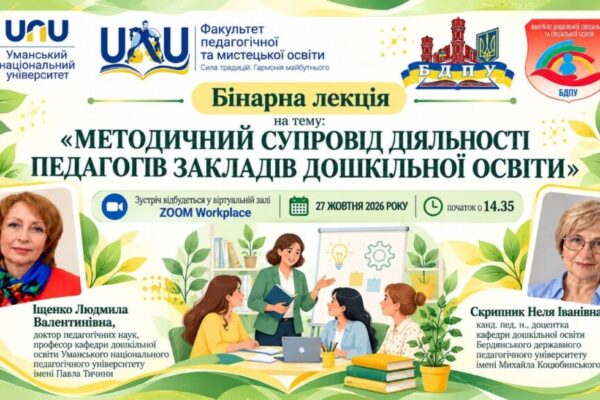
Joint lecture for master’s students: specifics of methodological support for the educational activities of educators in preschool educational institutions
On October 27, 2026, a joint lecture was held, focusing…
31 October 2026
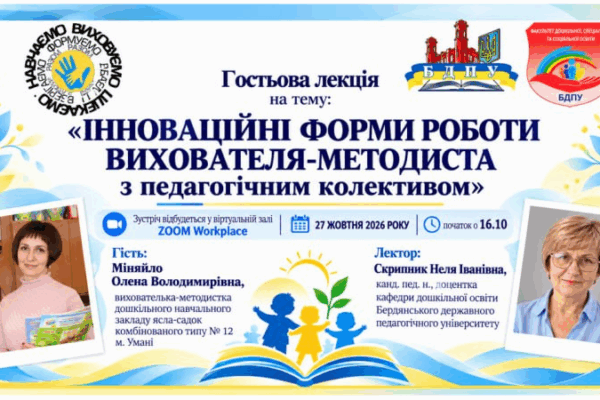
Guest lecture with a practitioner: innovation in early childhood education
How can an ordinary pedagogical seminar be transformed into a…
31 October 2026
From Small Acts to Big Hearts: How to Introduce Volunteering to Primary School Students
Can a child change the world for the better? The…
31 October 2026
The Quality We Create Every Day: Insights from Ukraine’s Leading Educators
Can a school's success be measured solely by the dry…
31 October 2026