
KSE: “predatory journals” and the academic environment
Admin
25 March 2026
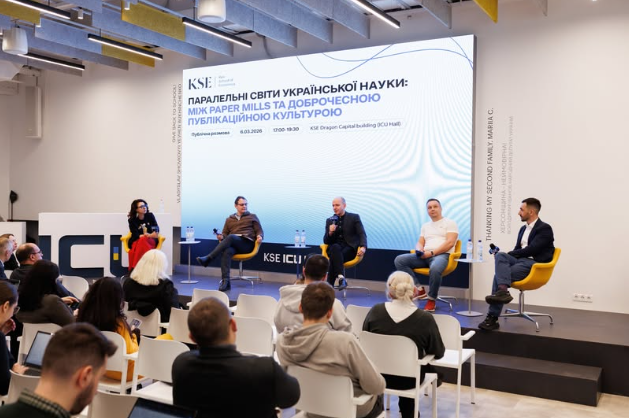
The Kyiv School of Economics (KSE) hosted an event that rekindled the discussion about so-called “predatory journals” in the academic environment.
The discussion focused on scholars and experts in academic communication, including Igor Serdiuk, Serhii Nazarovets, and Yana Sychikova, as well as international researchers, authors of new publications and analytical reports.
The discussion about such publications received new impetus thanks to an article in the journal Accountability in Research, which questions the established criteria for defining such journals.
During the event, Igor Serdiuk presented a case study with publications about a fictional country, an example that had previously been actively discussed on social networks. It was this speech that became the starting point for a broader conversation about the quality of academic publications and the criteria for evaluating them.
The problem is that the traditional division into “predatory” and “quality” journals is receiving increasing criticism. As Serhii Nazarovets noted, many researchers consider the term itself problematic or incorrect.
A new publication in the journal Accountability in Research has given the topic additional resonance. Its author analyzes whether the so-called “red flags” can also be found in legitimate journals. We are talking about signs that traditionally indicate unscrupulous publications:
- lack of peer review;
- aggressive invitations;
- guarantee of quick publication;
- hidden publication fees, etc.
As the study shows, some of these features do indeed occur even in publications indexed by prestigious databases.
This calls into question the effectiveness of popular tools for identifying dubious journals, in particular lists such as the one proposed by Jeffrey Beale or the modern Cabells database. They capture potential risks, but do not provide final quality assessments.
At the same time, a different approach is offered by the STM Association report, which focuses not on labels, but on mechanisms of abuse (article factories, manipulation of peer review). In response to these challenges, international initiatives such as COPE or Think. Check. Submit are emerging, helping researchers navigate the complex publishing environment.
Yana Sychikova drew attention to the study by Jaime Teixeira da Silva and Serhii Nazarovets, which demonstrates the transformation of the “publish or perish” principle into a more complex system of academic pressure.
As a result, the experts concluded: the problem of dishonest or questionable publications is much broader. It is a systemic issue related to the economics of scientific publications, requirements for scientists, and institutional incentives.
That is why, as the participants in the discussion emphasize, the solution requires a comprehensive approach: from reforming state policy in the field of science to developing a culture of research integrity.
Based on materials from Yana Sychikova’s Facebook page

Anniversary of a true champion who inspires generations
A solemn event was held at Berdyansk State Pedagogical University,…
26 March 2026

Cooperation between the Faculty of Social Sciences and Humanities at BSPU and the ‘Cultural and Arts Centre’ Municipal Institution of the Boyarka City Council
The modern cultural landscape requires not only talented artists, but…
26 March 2026

Stakeholder Meeting for Philological Specialisations
On 24 March 2026 at 2:00 PM, a scheduled stakeholder…
26 March 2026
Social and emotional learning as a tool for developing transversal skills of students in the new ukrainian school
On March 24, 2026, a guest online lecture titled «Social…
25 March 2026