
A step towards new generation electronics: research
Admin
9 April 2026
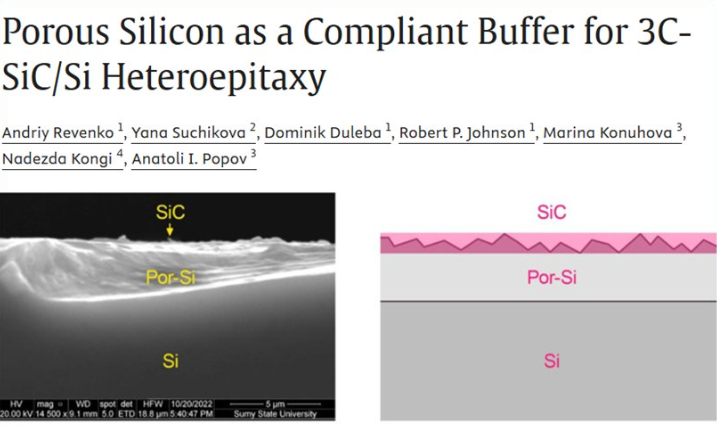
On April 7, 2026, a study co-authored by Yana Sychikova, Vice-Rector for Scientific Affairs of Berdyansk State Pedagogical University, became available on the web portal of the publication “Physica B: Condensed Matter”.
Yana Sychikova tall about publication of the article “Porous Silicon as a Compatible Buffer for 3C-SiC/Si Heteroepitaxy” on her Facebook page.
As she said, the main problem here is the “limitation” of silicon – the main material of all modern electronics. And it manifests itself precisely in powerful and high-temperature devices, which are extremely important for aviation, metallurgy, energy (both nuclear and thermal), mining, automotive industry …
That is, not only for development, but also for maintaining the existing standard of living of the population.
Even closer to everyday needs: “Phones, computers and electric cars are becoming more and more powerful, but traditional silicon chips start to overheat and lose efficiency when operating at high power”.
Among the authors of the work:
- Andriy Revenko, Dominic Duleba, Robert P. Johnson, employees of University College Dublin, Ireland;
- Yana Sychikova, BSPU;
- Marina Konukhova and Anatoliy I. Popov, Institute of Solid State Physics, University of Latvia;
- Nadezda Kongi, Institute of Chemistry, University of Tartu, Estonia.
Such international cooperation was converted into a solution – the use of silicon carbide. “It conducts heat perfectly, withstands enormous voltages and can work in extreme conditions”.
Even closer to everyday life: “this is another small laboratory step towards mass production of next-generation electronics: ultra-rugged sensors, medical implants and more powerful electronics”. These results “expand the prospects for their scalable application in high-temperature sensors, MEMS/NEMS devices and power microelectronics”.
In addition, the scientists’ solution “turned out to be much simpler and cheaper than using expensive multilayer alternatives made of rare metals”.
The research project was funded by the Ministry of Education and Science of Ukraine and partially supported by the Latvian-Ukrainian cooperation project “Synthesis and research of new optical materials for advanced applications” LV-UA/2025/12.
“Physica B: Condensed Matter” is a journal whose materials “cover the entire field of condensed matter physics, including theoretical, computational and experimental studies”. The publication focuses on research into nanostructures, nanomaterials, optics, quantum materials, etc.
The article is available at: https://doi.org/10.1016/j.physb.2026.418626
Based on materials from Yana Sychikova’s Facebook page

Books that open up space for conversation
After the summer break, the reading club brought together faculty…
7 October 2026

AІ week at FPPEA: from experiment to original projects
Artificial intelligence writes texts, creates images, analyzes information and helps…
7 October 2026

From first introduction to partnership: First-year students begin their educational journey
On 1 October 2026, the Department of Social Work and…
5 October 2026

Artificial Intelligence as a Tool for Modernizing the Professional Training of Future Psychologists
The rapid development of generative artificial intelligence opens up new…
5 October 2026