
Inattention, Procrastination or ADHD? How to Maintain Focus in the Digital Age
Admin
2 November 2026
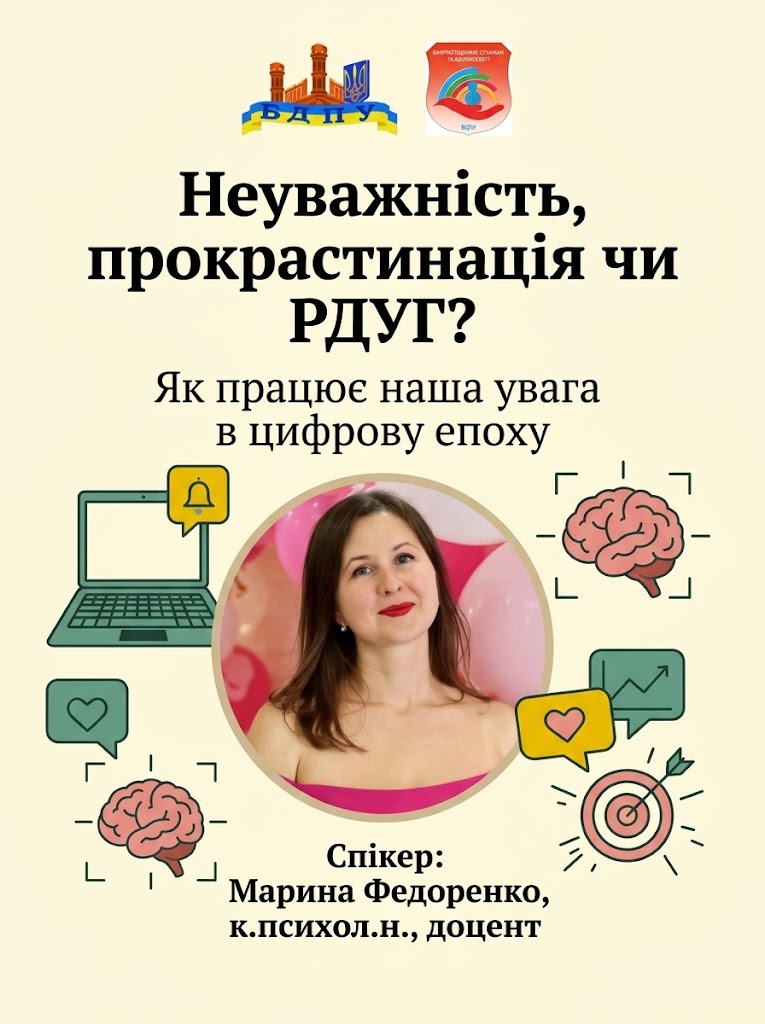
On 28 October 2026, a university-wide lecture entitled “Inattention, Procrastination or ADHD? How Does Our Attention Work in the Digital Age?” was delivered by Marina Fedorenko, PhD, Associate Professor at the Department of Applied Psychology and Speech Therapy.
The lecture provided an opportunity to look at familiar everyday situations through the lens of psychological science. Why is it that, when we sit down to work on an important task, we suddenly find ourselves scrolling through social media? Why do we put things off even when we know how important they are? And do difficulties with concentration always indicate attention-deficit/hyperactivity disorder (ADHD)?
Participants explored how different components of attention work, why frequently switching between tasks depletes cognitive resources, and how the digital environment competes for our attention. Particular attention was paid to the psychological mechanisms underlying procrastination, which is often not a sign of laziness but rather a way of avoiding anxiety, uncertainty, fear of making mistakes, or other unpleasant emotions.
A separate section of the lecture focused on ADHD, a neurodevelopmental disorder that should not be equated with ordinary inattention or excessive smartphone use. Using examples from everyday life, participants learned to distinguish between situational difficulties with concentration, procrastination, and possible manifestations of persistent difficulties with attention regulation. An important point was that outwardly similar behaviours may have very different underlying psychological and neurodevelopmental mechanisms.
The theoretical discussion was complemented by practical recommendations for organising everyday activities, ranging from managing digital notifications and breaking down complex tasks into manageable steps to using focused work intervals, switching attention mindfully, and ensuring adequate rest. Participants also had the opportunity to carry out a personal attention audit, reflect on the reasons behind their distractions, and identify the factors that make it difficult for them to concentrate.
Based on materials from the Department of Applied Psychology and Speech Therapy
The Geometry of Numbers: How Arithmetic Builds Polygons on a Plane and Polyhedra in Space
A logic puzzle for the senior kindergarten group: Draw five…
2 November 2026

BDPU Lecturers and Students Join Nationwide Physical Education Course
On October 29–31, 2026, academic staff of the Department of…
1 November 2026

BSPU Student Wins Five Medals at the World Karate Championship. International Success for a BSPU Student
From 23 to 25 October 2026, the 26th FSKA/FSKAW World…
1 November 2026

Finance with a halloween twist: a meeting of the scientific club “Current issues of economics and finance ”
As part of the activities of the “Current Issues of…
31 October 2026